Table of Contents
I am going to be honest with you about something. Before I started building Anea Hill, I was not someone who thought much about women's sunglasses polarized UV protection. I wore sunglasses the way most women do, I found a pair I loved the look of, checked that they felt okay on my face, and assumed the rest was handled. Polarized was a word I had seen on tags and labels but had never really investigated. If the frame was cute and the price felt reasonable, that was usually enough.
Seven years of building a luxury eyewear brand from the ground up changed that completely. Once I understood what women's sunglasses polarized UV protection actually means, what it does for your eyes, why lens quality matters more than almost any other factor, and why some polarized sunglasses give you headaches while others feel like a revelation, I could not go back to thinking about it any other way. This post is everything I wish I had known from the beginning.
What I Used to Think About Polarized Sunglasses
Before Anea Hill, polarized meant one thing to me. It was a feature that appeared on the more expensive pairs and seemed to make things look slightly darker and crisper. I assumed all polarized lenses were roughly equivalent, that paying for polarization meant you were getting the same thing regardless of the brand or price point.
That assumption was wrong in a way that I find genuinely important to share.
Not all polarized lenses are created equal. The difference between a well made polarized lens and a cheaply produced one is not subtle. It shows up in how clearly you see, how your eyes feel after two hours of wear, and whether you finish the day with a headache or without one. Understanding why that difference exists changed how I designed every Anea Hill frame from the first pair forward.
What Polarized Actually Means
Before getting into why some polarized sunglasses fail, it helps to understand what the technology is actually doing.
Light normally travels in waves moving in all directions simultaneously. When light reflects off a flat surface, water, a road, a car hood, wet pavement- those waves flatten and move predominantly in one horizontal direction. That concentrated horizontal light is what we experience as glare. It is the blinding flash off a windshield. The shimmer off the ocean that makes it hard to see. The way a parking lot looks almost white on a bright afternoon.
Polarized lenses contain a special polarizing filter that blocks these horizontal light waves while allowing vertical light to pass through. The result is a dramatically cleaner, sharper view with significantly less eye strain. Colors appear more vivid. Edges look crisper. The visual effort your eyes have to make simply decreases.
When it works properly, polarization does not just make sunglasses more comfortable. It makes the entire experience of being outside more enjoyable. That is a significant thing to get right.
Why Women's Sunglasses Polarized UV Protection Are Not the Same Thing
This is one of the most important distinctions in eyewear and one that most brands do not explain clearly enough.
Polarization and UV protection are two completely separate features that do two completely different jobs.
Polarization reduces glare. It is a comfort and visual clarity feature.
UV protection blocks ultraviolet radiation from reaching your eyes. It is a health feature.
Not all polarized lenses provide UVA and UVB protection automatically. Cleveland Clinic A lens can be polarized without blocking UV radiation, which means it reduces glare while leaving your eyes fully exposed to the ultraviolet light that causes long term damage. This is one of the most common misunderstandings in eyewear purchasing and one that has real consequences for long term eye health.
When shopping for women's sunglasses polarized UV protection, you need to verify both features separately on the label. Look for UV400 certification alongside the polarized designation. UV400 means the lens blocks all ultraviolet wavelengths up to 400 nanometers- the complete spectrum of UVA and UVB radiation that reaches your eyes every day.
At Anea Hill, both UV400 protection and polarized lenses are standard in every single frame. Not as separate upgrades. As the baseline, because both are non negotiable for eyes that are genuinely protected and genuinely comfortable.
Here is how to read labels when you shop:
| What the Label Says | Polarized | UV Protected | What It Means |
|---|---|---|---|
| Polarized + UV400 | Yes | Yes | Full coverage- both features confirmed |
| Polarized only | Yes | Not confirmed | Glare reduction without guaranteed UV protection |
| UV400 only | No | Yes | Eye health protection without glare reduction |
| No label | Unknown | Unknown | No verified protection- avoid |
Why Some Polarized Sunglasses Give You Headaches
This is the part of the conversation that I wish someone had explained to me earlier, because it took me a long time to understand why some polarized sunglasses feel like a revelation and others feel like they are working against you.
The short answer is lens quality. But the longer answer is more specific and more useful.
Cheaply made polarized lenses can distort your view, putting strain on your eyes and causing the onset of headaches. Poorly made lenses can have inconsistent structures, interfering with your vision and causing pain and discomfort.
Here is what that means in practice. The polarizing filter in a lens needs to be applied with precision and consistency across the entire surface. In a well made lens, that filter is uniform. Light is blocked and transmitted in exactly the way it should be, and your eyes receive a clean, undistorted image.
In a cheaply made polarized lens, that filter is inconsistent. Uneven tinting or distorted surfaces on low-quality lenses can change how light passes through, making your eyes work harder to adjust and leading to strain and discomfort. Over time, this fatigue can become near constant, especially if you wear them all day.
Your eyes are constantly trying to correct for what the lens is doing wrong. That effort accumulates into eye strain that presents as a headache, usually appearing after an hour or two of continuous wear. By the time the headache arrives, most women have already concluded that polarized sunglasses are not for them- when the real problem was never polarization itself but the quality of the lens delivering it.
There are several specific causes worth knowing:
Light leaks from poor fit: One of the reasons people end up with headaches while wearing polarized sunglasses is because of something called a light leak. This phenomenon occurs when sunglasses do not fit properly, allowing sunlight to enter the eyes from the side or from above the edges of the frame. Excess light entering the eyes causes strain as you squint to try to see.
Bounce back from flat frame curvature: One of the side effects of fashion orientated sunglasses with flat frame curvatures is the occurrence of bounce back. This is when rays of light get between your eyes and the rear surface of the lenses, reflecting backwards into your eyes, causing further strain, headaches, and discomfort.
Temple and frame pressure: Sunglasses that are too tight can put pressure on parts of your head, causing pinch points, soreness, and headaches. This is why it is important to have sunglasses fitted correctly.
Inconsistent polarizing filter: Low quality lenses can have distortions or imperfections that make your eyes strain to focus, which may cause headaches or dizziness. Lenses should provide clear, crisp sight without any waves or blurry spots.
The Real Reason Cheap Polarized Lenses Fail
Here is the honest version of why cheap polarized sunglasses consistently underperform.
Manufacturing a genuine high quality polarized lens takes time, precision materials, and quality control that adds cost at every stage of production. The polarizing filter needs to be applied uniformly. The lens material needs to be optically clear with no internal distortions. The curvature needs to be calibrated correctly so light reaches the eye at the right angle.
Cheap polarized sunglasses cut corners at each of these stages. The filter is applied inconsistently. The lens material has internal variations that create subtle distortions. The curvature is not calibrated for the way light interacts with the eye at the frame's angle.
A very small portion of people who try polarized lenses report feeling ill. This is exceedingly rare with high quality lenses and is usually caused by something other than the polarization itself, like low quality lens material. Harvard Health
The takeaway is straightforward. The polarization label on a pair of sunglasses tells you that some version of the technology is present. It does not tell you how well it was applied, how consistent the filter is, or whether the lens will feel comfortable after three hours of real daily wear. Only the quality of the manufacturing process determines that.
What Good Polarized UV Protection Actually Feels Like
This is the part I want every woman to experience at least once, because it genuinely changes your expectations permanently.
A well made pair of women's sunglasses with polarized UV protection should feel like this. You put them on. The world gets quieter visually. Not darker but clearer. Colors sharpen. Edges define themselves. The visual noise of glare simply disappears. And then you stop thinking about the sunglasses entirely because they are doing exactly what they are supposed to do without requiring any attention.
Glare accounts for much of the light reaching the eye on a sunny day and can be as big of a headache or migraine trigger as the sun's brightness itself. Harvard Health When that glare is properly eliminated by a well made polarized lens, the relief is immediate and significant. Eyes that have been working constantly against reflective light suddenly have nothing to fight.
After two hours of wearing well made polarized sunglasses, you should feel less fatigued than you would without them, not more. If you finish a day outdoors with a headache behind your eyes, the sunglasses you are wearing are not doing their job correctly. That is a lens quality problem, not a polarization problem.
How Anea Hill Approaches Lens Quality Differently
When I started designing Anea Hill frames, lens quality was one of the first non negotiables I established. Not because it was the most obvious place to start but because my own experience with light sensitivity after LASIK made me understand exactly what is at stake when lenses fail.
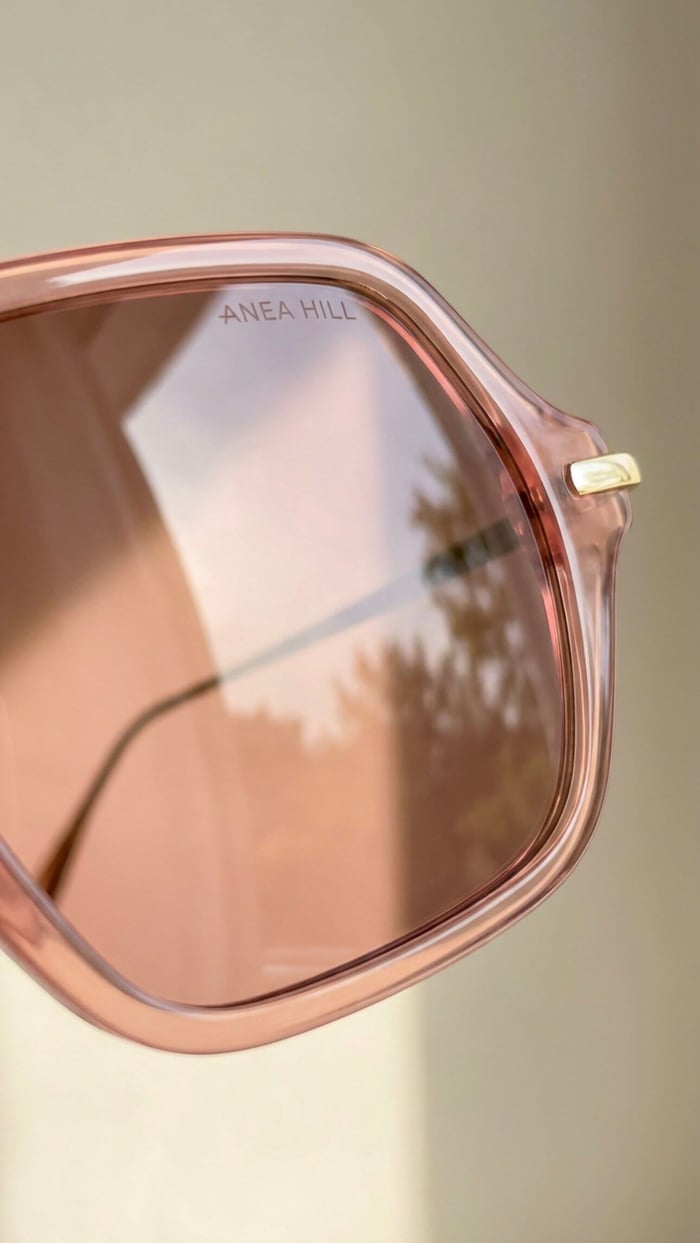
Every Anea Hill lens is crafted from a premium material that delivers optical clarity one level below glass without the heaviness or distortion that glass carries. The polarizing filter is applied consistently across the full lens surface with no variation in coverage or density. The result is a lens that reduces glare uniformly across your entire field of vision rather than selectively in some areas and not others.
Combined with UV400 certification as a standard across every frame, this means that every pair of Anea Hill sunglasses delivers both complete glare reduction and complete ultraviolet protection simultaneously without requiring you to verify each feature separately or trust a vague label.
The frame construction supports the lens quality at every level. Adjustable Italian acetate allows the frame to be shaped to your specific face, which eliminates the light leaks and pressure points that compromise even good lenses when the fit is wrong. Balanced weight distribution prevents the temple pressure that causes headaches independently of lens quality. Correct bridge depth prevents the frame from sliding and forcing your eyes to look through the lens at the wrong angle.
Everything works together. That is the difference between a frame designed around lens performance and one that treats the lens as an afterthought.
For more on how frame fit specifically contributes to headaches and how Anea Hill addresses this at the design level, our post on best women's sunglasses covers the full picture of what we evaluate in every frame.
The Styles Built Around Polarized UV Protection
Every Anea Hill frame carries polarized UV400 lenses as a standard. These are the styles I recommend most often for women who are looking for women's sunglasses polarized UV protection as a daily wear priority.
Hampton
Hampton is the frame I reach for when someone asks me which Anea Hill style delivers the most complete all day wearing experience. The timeless cat eye silhouette works across a wide range of face shapes. The adjustable acetate fits precisely. The polarized UV400 lenses perform exactly as they should from the first moment you put them on. No adjustment period. No visual distortion. No headache by midday.
Hampton

$413.00
Hampton Polarized Sunglasses by Anea Hill If you are searching for the best sunglasses for women 2026, Hampton is the pair that quietly does it all. Designed as a signature accessory, the Hampton sunglasses combine timeless style with modern performance.… read more
Tahoe
Tahoe delivers the same polarized UV400 standard in an oversized silhouette that provides additional coverage around the eye area. More frame coverage means less peripheral UV exposure and fewer light leaks- the kind of detail that matters when you are wearing sunglasses all day in full sun.
Tahoe

$384.00
A statement in motion, Tahoe captures the feeling of light dancing across water at golden hour. Designed in a refined, thinner silhouette, this frame brings a lighter touch to one of ANEA HILL’s most loved shapes. The confetti-inspired acetate blends… read more
Lily
Lily brings women's sunglasses polarized UV protection into a frame designed specifically for smaller features. The adjustable acetate fits more precisely on petite face shapes, which eliminates the light leaks and pressure points that disproportionately affect women with smaller faces wearing standard sized frames.
For women with smaller features who have struggled with both fit and lens comfort, Lily is often the first pair that resolves both problems simultaneously. For more on finding the right fit for smaller faces, our guide on sunglasses for small faces covers everything you need to know.
Lily

$398.00
Effortlessly chic, endlessly wearable. Lily is the perfect blend of soft purple sophistication and warm brown lenses, offering a modern take on timeless elegance. Designed for all-day comfort with Anea Hill’s signature adjustable fit, these handcrafted sunglasses are as luxurious… read more
Final Thoughts
Women's sunglasses polarized UV protection is not a single feature. It is a combination of lens quality, consistent filter application, UV certification, and frame fit working together to protect your eyes and make wearing sunglasses feel effortless rather than effortful.
I did not know any of this before I started Anea Hill. Now that I do I cannot unknow it. And once you experience what well made polarized UV400 lenses actually feel like, you will not want to go back to anything less.
"I have spent years buying designer sunglasses that looked beautiful but gave me headaches within an hour. Anea Hill is the first pair I can wear all day without even thinking about them. The fit is completely different because you can actually adjust them, which I did not realize I needed until now. They feel balanced, light, and intentional. This is what luxury should feel like." -Charlotte B., Verified Customer
Ready to experience the difference that lens quality and frame fit actually make? Browse the full Anea Hill collection and discover women's sunglasses with polarized UV protection built to perform every single day.
FAQs
Do all polarized sunglasses provide UV protection?
No and this is one of the most important things to understand when shopping for women's sunglasses polarized UV protection. Polarization and UV protection are two separate features. A lens can reduce glare through polarization without blocking ultraviolet radiation unless it also carries a UV400 coating. Always look for UV400 certification alongside the polarized designation. At Anea Hill, every frame includes both UV400 protection and polarized lenses as a standard so you never have to verify each feature separately.
Why do some polarized sunglasses give me a headache?
Headaches from polarized sunglasses are almost always caused by lens quality rather than polarization itself. Cheaply made polarized lenses have inconsistent polarizing filters that cause subtle visual distortion, forcing your eyes to work harder than they should throughout the day. That effort accumulates into eye strain that presents as a headache. Frame fit also contributes, a frame that is too tight creates temple pressure, and a frame that fits poorly allows light leaks that add to eye strain. High quality polarized lenses with consistent filter application and a well fitting adjustable frame eliminate both of these problems.
How do I know if my polarized sunglasses are good quality?
The clearest test is how your eyes feel after two to three hours of continuous wear in full sun. Well made polarized sunglasses should leave you feeling less fatigued than you would without them, not more. If you finish a day outdoors with a headache or eye strain, the lens quality or frame fit is the problem. Look for frames built from adjustable acetate with UV400 certified polarized lenses from a brand that is transparent about its materials and manufacturing process. For a full breakdown of the best polarized options for women in 2026, our post on best sunglasses for women 2026 covers every style worth knowing.